

- This event has passed.
Research Seminar (Gregory Sawicki)
April 21 @ 12:00 pm – 1:00 pm
IMSI Research Seminars are open to the public. Email CIMS@uci.edu for Zoom access or tune in using the YouTube livestream link below.
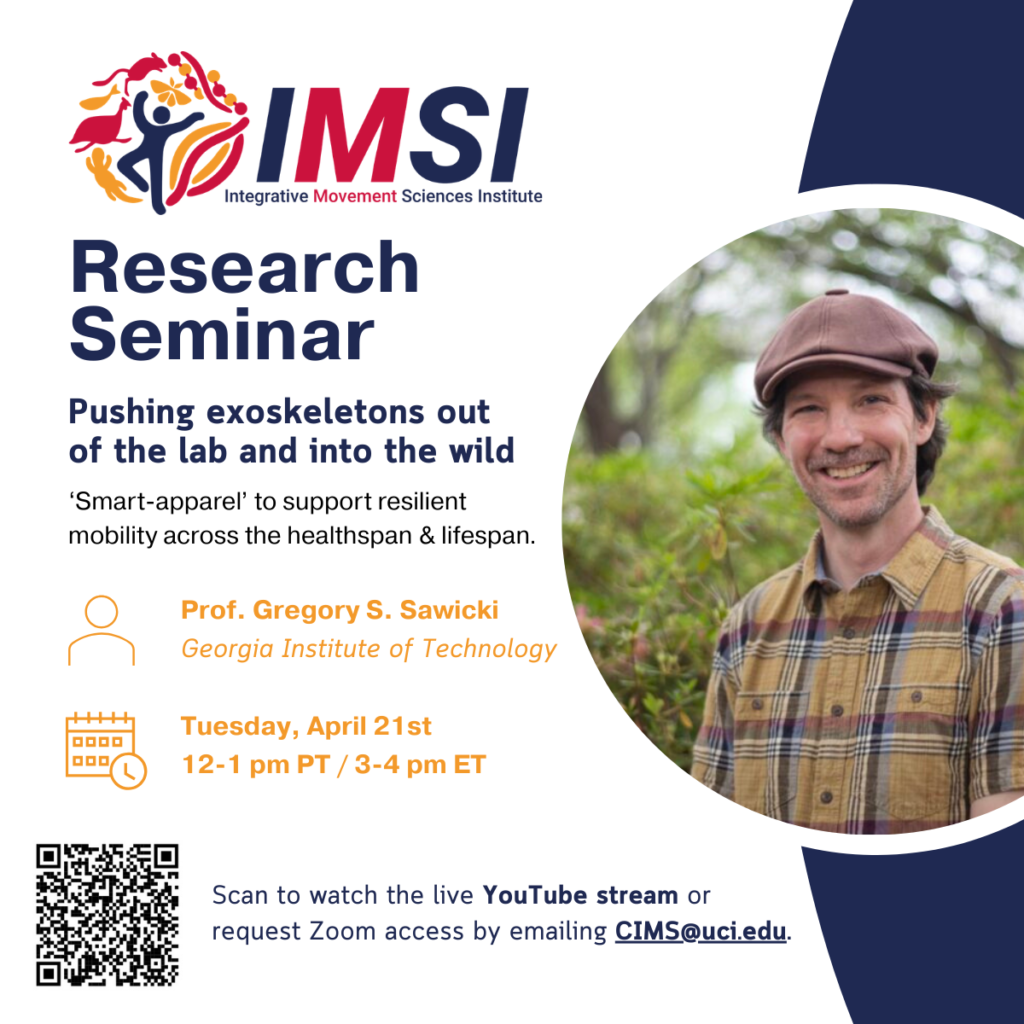
Title: Pushing exoskeletons out of the lab and into the wild: ‘Smart-apparel’ to support resilient mobility across the healthspan and lifespan.
Speaker: Prof. Gregory S. Sawicki (Georgia Institute of Technology)
Date: Tues, April 21, 12-1pm PT / 3-4pm ET
Location: UC Irvine, NatSci I, Rm 1114
YouTube Livestream: https://youtube.com/live/AvL5jThOZvM?feature=share
(Or email CIMS@uci.edu for Zoom access)
Speaker Bio: Dr. Gregory S. Sawicki is a Professor and Joseph Anderer Faculty Fellow at Georgia Tech with appointments in the School of Mechanical Engineering and the School of Biological Sciences. In 2025-2026, Sawicki will serve as the Interim Executive Director of Georgia Tech’s Institute on Robotics and Intelligent Machines (IRIM).
Sawicki completed his Ph.D. in Human Neuromechanics at the University of Michigan, Ann-Arbor (‘07) and was an NIH-funded Post-Doctoral Fellow in Integrative Biology at Brown University (‘07-‘09). Sawicki was a faculty member in the Joint Department of Biomedical Engineering at NC State and UNC Chapel Hill from 2009-2017. In 2023, Sawicki was awarded the American Society of Biomechanics Founders’ Award for scientific accomplishment in biomechanics and excellence in mentoring.
Sawicki directs the Human Physiology of Wearable Robotics (PoWeR) laboratory—where the goal is to combine tools from engineering, physiology and neuroscience to discover neuromechanical principles underpinning optimal locomotion performance and apply them to develop lower-limb robotic devices capable of improving both healthy and impaired human locomotion (e.g., for elite athletes, aging baby-boomers, post-stroke community ambulators).
Abstract: Our aim in the Human Physiology of Wearable Robotics (PoWeR) Laboratory is to discover and exploit key principles of locomotion neuromechanics in order to build wearable devices that can augment intact or restore impaired human locomotion. Over the past 10+ years we have taken a lower-limb joint and muscle-level approach to develop physiologically-inspired ankle and hip exoskeletons that aim to improve walking economy. Reducing effort and increasing speed for people post-stroke and in natural aging are important use-cases for exoskeletons – but other objectives such as improving balance or delivering body-borne, targeted resistance training may also be key for improving mobility. This talk will highlight some key foundational studies in the archive and touch on our recent collaborative projects that leverage wearable sensing & AI to speed the transition of bioinspired wearable technology out of the lab toward impact in ‘real-world’ environments in the form of ‘smart-apparel’ to support resilience across the lifespan.