
Now Recruiting Trainees for the 2026 IMSI Summer Institute!
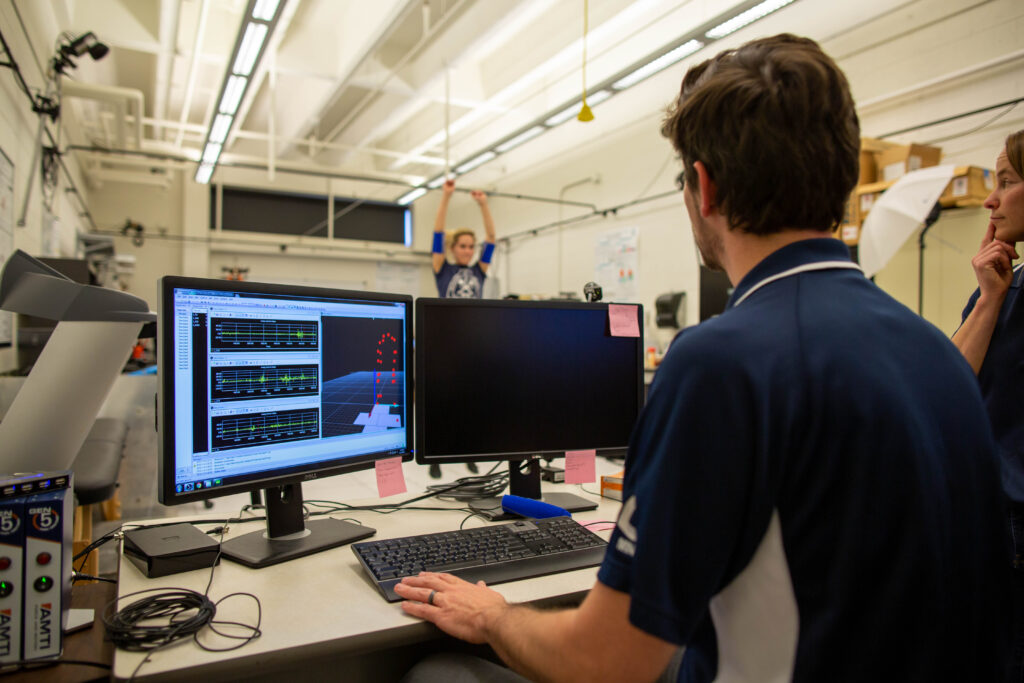
Why do some animals hop while others run? How do muscles, tendons, and neural circuits work together to produce agile, stable movement? And how does sensory feedback shape balance and coordination? The IMSI Summer Institute 2026 (IMSI-SI 2026) research trainees will investigate these questions and more as they study the principles of movement across biological scales, from molecular-scale muscle dynamics to whole-body mechanics and sensorimotor control.
IMSI-SI 2026 is a research training internship that brings together researchers from more than 20 institutions to explore movement through experiments, computational modeling, robotics, and human-subject research. Projects span muscle–tendon mechanics during cyclical contractions, integrative feedforward–feedback control models, robotic tests of balance inspired by avian morphology, video-based motion capture validation, and sensory-feedback systems for prosthetic devices. Research trainees will gain hands-on experience in data analysis, experimental design, and computational methods while working collaboratively with leading scientists across biomechanics, physiology, neuroscience, and applied mathematics.
Research Focus: Research trainees will contribute to projects that explore:
- Molecular mechanisms of muscle contraction and models of muscle contraction dynamics
- How muscles control movement under unsteady or challenging conditions
- The integration of molecular, neural, and mechanical systems in locomotion
- Comparative biomechanics across species to understand evolutionary diversity of movement
- Movement in real-world, ecologically complex environments
Keep reading to find out about program details, application instructions, and available projects!
Program Details:
Who should apply: We accept applicants from all career stages and academic disciplines. Undergraduates are especially encouraged to apply.
What: Participants will engage in full-time, in-person research over 6-10 weeks (depending on the project), working closely with faculty mentors and research teams, with some remote or part-remote options for specific approved projects. Weekly virtual workshops will deepen interdisciplinary learning, and trainees will present their findings at a Capstone Symposium on September 10th and 11th, 2026 (hybrid format, dates to be confirmed).
Dates differ based on host institution, but generally fall between June 1st – August 21st, 2026
Research Locations: UC Irvine, UC Riverside, USC, Georgia Tech, Emory University, Washington State University, Argonne National Lab, Florida State University, and other partner institutions.
Funding & Support
- Trainees: $600/week training stipend for full-time participation, subject to NSF eligibility rules*
- Housing and travel support are available for trainees conducting research away from their home institution. Housing arrangements will need to be coordinated through IMSI to confirm use of university-approved accommodations.
Training & Mentorship: IMSI-SI 2026 provides interdisciplinary workshops, research mentorship, and training in team science and communication. Trainees will receive outstanding support through near-peer mentoring, collaborative co-supervision by faculty and will have access to mentorship training through the Excellence in Mentoring program, supporting their development as researchers, science communicators and educators.
* Funding eligibility: Training stipends will be subject to confirmation of NSF eligibility. There are some restrictions on the distribution of stipend support, including specific cases below:
- Current UCI employees (faculty, staff, postdocs) are ineligible for stipend support. Individuals who fall into this category should speak to Dr. Daley about alternative funding mechanisms. This restriction does not apply to UCI undergraduates or graduate students who work part-time on campus.
- Postdocs and graduate students who are fully supported on the IMSI grant at a subawarding institution, or fully supported on other federal government sources cannot also receive a participant support stipend. However, these individuals are welcome and encouraged to participate fully in IMSI training activities.
- Individuals with alternative sources of funding for the Summer who are working in IMSI-affiliated labs (including the specific cases above), are welcome to participate fully in the IMSI training program and will receive recognition as IMSI participants.
Interested in joining IMSI-SI 2026?
Professional Recommendation Requirement: The application will require 1-2 professional recommendations. Each applicant must arrange for 1-2 mentor/supervisor(s) to submit a recommendation on their behalf by March 21st using this form: https://forms.gle/mrUtewQsk3LBUja28
Application Deadline: March 21st, 2026
If needed, you can copy and paste the application link into a browser of your choice: https://forms.gle/KZYF55Nyba4tbEhJ6
Available IMSI-SI 2026 Research Projects
Note: Project details and availability are subject to change and will be confirmed in offer letters.
Clamp and Ramp: System identification to estimate mechanical muscle properties in clamp and ramp shortening experiments
- Description: We are building system identification models that use experimental data to estimate the mechanical properties of muscle. By analyzing load clamp and ramp shortening experiments, we aim to quantify how muscles store, dissipate, and transmit force.
- Faculty collaborators: Kiisa Nishikawa, Jenna Monroy
- Location: Claremont College & Northern Arizona University
- Dates: 6/1/26 – 8/15/26
Bullfrog Muscle Power: Active Stiffness and Titin Isoforms
- Description: Examine the active stiffness of bullfrog muscles with different titin isoforms in this lab-based study hosted at UCR. This project explores the mechanical properties of muscles and their variations across species, offering insight into muscle function in amphibians.
- Faculty collaborators: Natalie Holt, Kiisa Nishikawa, Jenna Monroy
- Location: UC Riverside
- Dates: 7/1/26 – 8/15/26
Pop-Up Movement Science Arenas
- Description: How do humans navigate challenging environments? How do individuals adapt foot placement and movement strategies when negotiating varied terrain and spatial constraints? This project aims to capture human movement footage and apply pose estimation and motion analysis software to examine foot placement strategies in relation to center-of-mass (COM) trajectories. The goal is to identify the biomechanical and decision-making variables that influence how individuals prioritize stability, efficiency, and adaptability when navigating complex terrain.
- Faculty collaborators: Kelli Sharp, Jill McNitt-Gray, Nidhi Seethapathi
- Location: Remote
- Dates: 7/1/26 – 8/15/26
Why Go Bipedal?: Lizard Gait Strategies Across Varying Terrain
- Description: This project combines fieldwork and laboratory experiments to examine how rock- and sand-dwelling lizards switch between quadrupedal and bipedal movement across sandy, firm, and rocky terrain. Participants will collect data outdoors (including camping-based field sessions) and analyze locomotion under controlled conditions.
- Faculty collaborators: Clint Collins, Craig McGowan, Monica Daley
- Location: Tonopah Junction, Nevada & Sacramento State, UC Irvine, or USC (lab/field hybrid)
- Dates: 6/1/26 – 7/17/26
Front Heavy: Neuromechanics of Adaptation to Added Mass in Standing Balance
- Description: Falls during pregnancy are common but not well understood. This project isolates the mechanical effects of added mass to examine how individuals adjust their muscle control and balance strategies, helping identify factors that contribute to stability or instability. The findings will shed light on fall risk in pregnancy and reveal general principles of how animals adapt to changing body dynamics.
- Additional information provided by study team: This project involves collection and analysis of human biomechanics data (motion capture, EMG) and neural data (EEG) to characterize adaptation of reactive balance responses. Trainees will also be introduced to computational modeling techniques that help explain neural control of standing balance. Intermediate experience with coding (MATLAB) and physics is preferred. Previous experience collecting human biomechanics data is a plus but not required.
- Faculty collaborators: Greg Sawicki, Lena Ting
- Location: Emory University (Emory Rehabilitation Hospital)
- Dates: 6/29/26-8/21/26
Fibers to Function: Mechanical system analysis of permeabilized skeletal muscle fibers and cardiac muscle strips
- Description: This project analyzes permeabilized skeletal and cardiac muscle tissue to identify key mechanical parameters and integrate them into computational models of muscle contraction. By linking single-fiber measurements to whole-muscle behavior, we aim to advance multi-scale modeling of how muscles generate force.
- Faculty collaborators: Bert Tanner, Kiisa Nishikawa
- Location: Washington State University
- Dates: 7/1/26-8/15/26
Navigating Nature: Examining how kangaroo rats navigate rocky terrain at increasing levels of coverage
- Description: How do animals pick their path? Dive into the biomechanics of how animals choose their path in challenging environments, exploring foot placement strategies and the decision-making processes that help them navigate complex terrains.
- Faculty collaborators: Craig McGowan, Nidhi Seethapathi
- Location: University of Southern California
- Dates: 6/1/26-7/31/26
Branching Out: Visual Cues and Locomotion in Tree Shrews
- Description: Life in the trees means navigating an obstacle rich, visually cluttered environment that offers very limited foot placement options. Explore how visual cues and substrate complexity impact tree shrew biomechanics and path choice.
- Faculty collaborators: Craig McGowan, Addison Kemp
- Location: University of Southern California
- Dates: 6/1/26-7/31/26
Momentum in Motion: Manipulating angular momentum to stabilize non-steady locomotion
- Description: The goal of this project is to identify how angular momentum of individual body segments of Dipodomys deserti, the desert kangaroo rat, are coordinated during the airborne phase to set landing conditions upon an up-sloped perturbation.
- Faculty collaborators: Craig McGowan, Jill McNitt-Gray
- Location: University of Southern California
- Dates: 6/1/26-7/31/26
Similar Sinews: Comparing Kangaroo Rat Tendon Properties
- Description: Are all tendons the same? Deserti kangaroo rat ankle extensor tendons are reported to have rather extraordinary material properties; however, it is not known if these properties are specific the this species or common to all kangaroo rats. This project will analyze the material properties of tendons from cadavers of California k-rats.
- Additional information provided by study team: Engineering or material science experience would be valuable.
- Faculty collaborators: Craig McGowan, Crystal Reynaga, Manny Azizi
- Location: University of Southern California & partner institution
- Dates: 6/1/26-7/31/26
Striations and Specialization: Do molecular-scale structural dynamics explain functional differences in a diverse group of striated muscles?
- Description: Striated muscle function emerges not solely from gross fiber architecture but from fine-scale molecular interactions. This project uses a comparative approach, analyzing cross-striated flight muscles in insects and obliquely striated retractor muscles in annelids, to determine how molecular dynamics shape differences in force production, elasticity, and contractile kinetics under dynamic operating conditions. By linking molecular-level behavior to fiber- and whole-muscle function, we aim to uncover fundamental mechanisms underlying the evolution of muscle specialization.
- Additional information provided by study team: Previous experience with x-ray diffraction experiments would be valuable
- Faculty collaborators: Joe Thompson, Simon Sponberg
- Location: Darling Marine Center (University of Maine), Georgia Tech, and Argonne National Lab
- Dates: 6/15/26-8/7/26
Functioning with Fatigue: Effects of Muscular Fatigue on Movement Performance
- Description: This project explores the effects of muscular fatigue on human movement performance. Students will help collect data and analyze hopscotch performance, and advanced participants will work with video and optical motion capture to quantify kinematic changes. The study bridges experimental biomechanics and applied motion tracking, revealing how fatigue influences coordination and movement strategies.
- Faculty collaborators: Katie Knaus, Anne Silverman, Jill McNitt-Gray
- Location: Colorado School of Mines
- Dates: 6/15/26-8/7/26
Why Don’t Humans Hop? (Integrative Modeling)
- Description: Bipedal hopping is a specialized form of locomotion in mammals like kangaroos and hopping rodents, while humans mostly walk and run. Using state-of-the-art computational and optimal control methods, trainees will test whether humans could hop efficiently and how the metabolic cost of hopping compares to running. Work will be done at Florida State University/Florida A&M and will complement ongoing experimental studies at UC Irvine (see project description below).
- Additional information provided by study team: The ideal trainee will have an interest in simulation and control of dynamical systems and their application to biomechanics, a positive attitude toward engaging and motivating research participants, and a basic understanding of physics, calculus, differential equations, procedural programming (any language), and an aptitude for learning and debugging.
- Faculty collaborators: Christian Hubicki, Monica Daley
- Location: Florida State University
- Dates: 6/15/26-8/15/26
Why Don’t Humans Hop? (Integrative Experiments)
- Description: This project collects and analyzes hopping behavior in humans and bipedal hopping animals to support computational modeling. Trainees will assist with human-subject experiments, capturing kinematic, kinetic, and metabolic data during hopping and running trials. The resulting data will inform complimentary modelling efforts conducted at a partnering institution (see project description above) and help reveal efficiency, limb mechanics, and functional differences across species.
- Additional information provided by study team: The ideal trainee will have an interest in biomechanics and athletic performance, a positive attitude toward engaging and motivating research participants, and a basic understanding of biomechanical, physiological, and anatomical principles.
- Faculty collaborators: Monica Daley, Christian Hubicki
- Location: UC Irvine
- Dates: 6/15/26-8/15/26
Elasticity & Stability: The Role of Distal Limb Tendon-Based Elasticity in Stability of Avian Bipedal Locomotion
- Description: This project will investigate how tendon elastic elements in the distal limb and feet of birds contribute to stability under substrate perturbations. BirdBot, a simplified bird-inspired bipedal robot, provides an ideal platform to isolate the mechanical contribution of tendon elasticity. By developing a BirdBot-inspired MuJoCo model with CPG-RL control, we will measure stability and energy cycling while systematically varying spring and damping properties.
- Additional information provided by study team: Trainees will utilize coding (Python) skills and basic physics or mechanics (forces, springs, energy) knowledge
- Faculty collaborators: Monica Daley
- Location: UC Irvine
- Dates: 6/29/26-8/21/26
Morphology Matters: How does avian foot morphology influence balance stability?
- Description: This project will investigate how avian foot morphology influences balance stability in bipedal systems. Robotic feet inspired by terrestrial birds will be designed and tested under systematic external perturbations applied in four transverse-plane directions: cranial, caudal, medial, and lateral. We quantify perturbation tolerance and recovery dynamics to reveal morphology driven contributions to balance stability. Robotic feet modeled after the avian feet will be compared against a simplified bar-shaped foot.
- Additional information provided by study team: Ideal trainees will have some experience designing 3D models in CAD programs, 3D printing and basic programming experience.
- Faculty collaborators: Monica Daley
- Location: UC Irvine
- Dates: 6/29/26-8/21/26
Feedforward and Feedback: Development of an integrated feedforward- feedback model of sensorimotor control of guinea fowl locomotion
- Description: This project focuses on analyzing guinea fowl locomotion data to prepare inputs for an integrated feedforward-feedback model of sensorimotor control. Trainees will process kinematic and EMG datasets to identify feedforward contributions using CPG-oscillator models, while postdoc and graduate mentors handle biophysical modeling of feedback components. Work will include creating continuous gait cycles, handling missing data, and computing averaged cycles for model input, providing experience in data analysis, neuromechanical modeling, and MATLAB-based workflows.
- Additional information provided by study team: Ideal trainees will have some basic programming skills, preferably in Matlab.
- Faculty collaborators: Monica Daley, Lena Ting
- Location: UC Irvine
- Dates: 6/29/26-8/21/26
Sensory Prosthesis for Restoring Ankle Position and Load Feedback
- Description: People with lower-limb amputations often lose proprioception, making walking less stable and more tiring. This project builds a “smart” prosthetic that measures foot pressure and ankle motion and delivers gentle electrical feedback to improve limb awareness. Trainees will help design hardware, program real-time feedback, and test the system first in unimpaired adults before applying it to prosthetic users.
- Faculty collaborators: Sasha Voloshina, Monica Daley
- Location: UC Irvine
- Dates: 6/29/26-8/21/26
Can Muscle Stimulation Change How We Sense Ankle Position?
- Description: After a stroke, many people lose part of their ability to sense ankle position, even if movement is regained. This project explores whether electrical stimulation of the ankle muscles can alter proprioception, using the Ankle Measuring Proprioceptive Device (AMPD) to precisely measure joint sense. Trainees will focus on building and testing the stimulation hardware and software and evaluating feasibility in unimpaired adults.
- Faculty collaborators: Sasha Voloshina, Monica Daley
- Location: UC Irvine
- Dates: 6/29/26-8/21/26
Can Spinal Stimulation Change How We Sense Ankle Position?
- Description: Stroke survivors often experience impaired ankle proprioception, making movement less coordinated. This project tests whether non-invasive transcutaneous spinal cord stimulation (tSCS) can enhance ankle position sense, measuring effects with the AMPD. Trainees will develop the stimulation setup, test different frequencies, and establish feasibility in unimpaired adults to support future clinical studies.
- Faculty collaborators: Sasha Voloshina, Monica Daley
- Location: UC Irvine
- Dates: 6/29/26-8/21/26
Muscle-Tendon Synergy: Impacts of increased tendon mechanical properties on limb kinematics
- Description: The proposed project uses a collagen crosslinking agent to experimentally alter tendon mechanical properties in vivo, and then studies its effects on locomotion. Trainees will learn how to work with animals, collect high-speed videos, track landmarks using DeepLabCut, and analyze joint kinematics.
- Faculty collaborators: Manny Azizi, Kiisa Nishikawa, Monica Daley
- Location: UC Irvine
- Dates: 6/29/26-8/21/26
Integrative Muscle Modeling: Bridging Muscle Models Across Scales
- Description: Muscle function can be described at multiple scales—from molecularly resolved filament models to tissue-level viscoelastic approximations—but linking predictions across scales remains a major challenge. This project uses existing experimental and X-ray diffraction data to test how parameters from detailed models can inform higher-level muscle representations, and under what conditions these reductions hold. Trainees will implement multi-scale muscle models, compare predictions to the same experimental datasets, and help bridge molecular, fiber, and whole-muscle dynamics in collaboration with faculty and postdoc mentors from multiple labs.
- Additional information provided by study team: The ideal student has a background in biophysics, quantitative biology. or bioengineering with an experience working in python or related languages. Undergraduates and early graduate students with an interest in understanding and building out computational models of muscles should consider this project. Some understanding of the basic structure of muscle will be helpful but can be learned in the first stages of the project.
- Faculty collaborators: Simon Sponberg, Kiisa Nishikawa, Bert Tanner
- Location: Georgia Tech & NAU
- Dates: exact dates TBD, early June through early August (8-10 weeks)
Don’t trip: Understanding the functional use of the proximo distal gradient during perturbations
- Description: This project aims to understand how humans use the different morphology of their joints to maintain stability while running. Vertical perturbations will be applied to subjects using a modified bump’em system. By studying perturbed locomotion, we can understand how the motor control system leverages the strengths and weaknesses of the muscles in our body to overcome challenging conditions. Summer activities will include designing / testing experimental paradigms, assessing motion capture and ground reaction force data, and interpreting control signals from motion data.
- Additional information provided by study team: Project trainees should be competent in both physics and biology, with some experience in coding.
- Faculty collaborators: Monica Daley, Sasha Voloshina
- Location: UC Irvine
- Dates: 6/29/26-8/21/26
Muscle fibers geared up: How tendon elasticity influences fiber rotation in pennate muscle-tendon units.
- Description: This project will involve in situ bench top experiments on muscle under controlled contraction conditions to investigate how muscle fibers interact with elasticity in dynamic muscle contractions. We will measure tendon and muscle fiber strains as well as fiber rotation in pennate muscles to understand how fiber rotation and shape change impact muscle function.
- Additional information provided by study team: Project trainees should be competent in both physics and biology, with some experience in coding.
- Faculty collaborators: Monica Daley, Manny Azizi
- Location: UC Irvine
- Dates: 6/29/26-8/21/26
Tension and Motion: The Muscle-Tendon Dance in Vivo
- Description: Investigate how muscles and tendons interact in living organisms. This project will involve in vivo (live animal) measurements of muscle tendon force, muscle fiber length and activity (using electromyography, EMG), to investigate variation in muscle function in non-steady movements and how interactions between tendon elasticity and muscle fibers influence force and work output in dynamic movement tasks.
- Additional information provided by study team: Project trainees should be competent in both physics and biology, with some experience in coding.
- Faculty collaborators: Monica Daley, Manny Azizi
- Location: UC Irvine
- Dates: 6/29/26-8/21/26
Staying on Your Feet: How Capacity Shapes Balance Resilience
- Description: Explore how variations in physical capacity influence resilience to balance disturbances during walking. Examine how individuals respond to perturbations, adapt their gait, and maintain stability in dynamic environments. Findings will inform strategies for improving mobility, injury prevention, and rehabilitation.
- Faculty collaborators: James Finley
- Location: University of Southern California
- Dates: 6/17/26-8/14/26
Read about last year’s Summer Institute: https://cims.uci.edu/science-that-makes-you-move/
Please reach out to IMSI program manager Victoria Wood (victoria.wood@uci.edu) with questions or concerns.